 By admin
 Indian Railways is one of the largest railway networks in the world, connecting thousands of cities, towns, and villages across the country. While every railway station plays an important role, railway junctions are considered the backbone of the network. They connect multiple railway routes, allowing trains to change direction and passengers to travel between different parts of India with ease.
If you have ever wondered what a railway junction is, how it is different from a normal railway station, or why some junctions are more important than others, this guide explains everything in simple words.
What Is a Railway Junction?
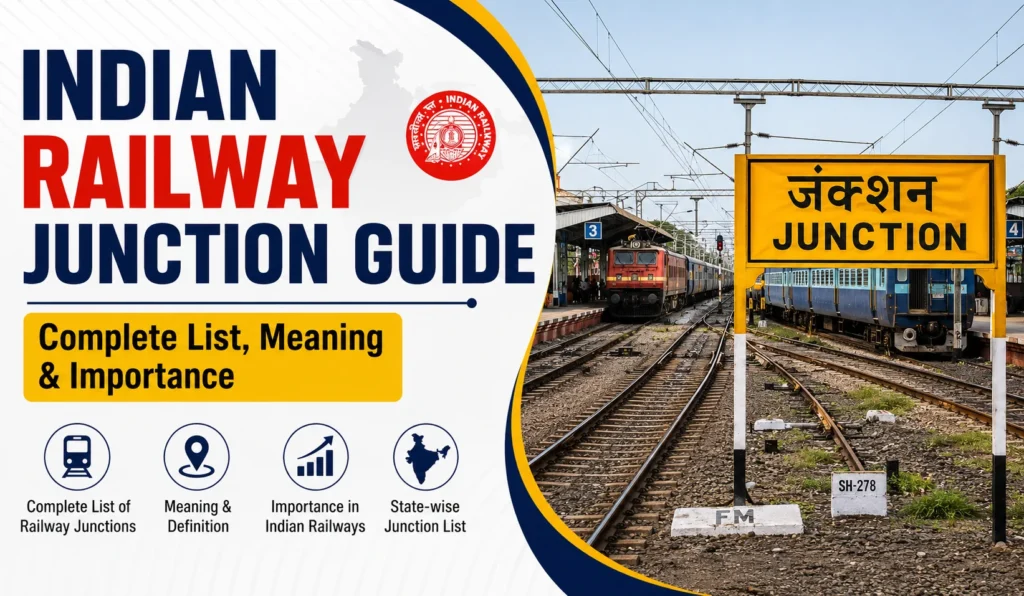
A railway junction is a railway station where three or more railway routes meet or branch out. Unlike an ordinary railway station, a junction allows trains to continue on different routes without retracing their path.
For example, a train arriving at a junction may continue towards another city using a different railway line, making the station an important interchange point for passengers and freight trains.
Example
Suppose a train reaches a junction from Delhi. From there, it may continue towards:
- Mumbai
- Chennai
- Kolkata
Since multiple routes are available, the station is called a railway junction.
Difference Between a Railway Station and a Railway Junction
| Feature | Railway Station | Railway Junction |
| Railway Lines | One or two routes | Three or more routes |
| Route Options | Limited | Multiple directions |
| Train Connectivity | Local or regional | Regional and long-distance |
| Passenger Transfers | Less common | Very common |
| Operational Importance | Moderate | High |
Simply put, every junction is a railway station, but not every railway station is a junction.
How Does a Railway Junction Work?
Railway junctions are designed with multiple railway tracks, points, and signaling systems that help trains safely move from one route to another.
The station controls:
- Arrival of trains
- Departure schedules
- Track changes
- Platform allocation
- Signal management
- Freight train movement
- Passenger transfers
Large junctions often operate round the clock because trains arrive and depart throughout the day.
Why Are Railway Junctions Important?
Railway junctions play a crucial role in the Indian Railways network.
Better Connectivity
Passengers can travel to different regions without changing multiple trains.
Easier Train Diversion
If one route is blocked due to maintenance or weather conditions, trains may be diverted through another route.
Freight Transportation
Most freight trains carrying coal, cement, food grains, petroleum products, and industrial goods pass through major railway junctions.
Economic Growth
Cities with major railway junctions often become business and logistics hubs due to better transportation facilities.
Passenger Convenience
Junctions usually offer better facilities such as waiting rooms, retiring rooms, food stalls, parking, and multiple train options.
Types of Railway Junctions in India
Although Indian Railways officially classifies stations based on operational needs rather than passenger categories, junctions can generally be grouped as follows.
Major Railway Junctions
These handle hundreds of trains every day and connect several important routes.
Examples include:
- New Delhi Junction
- Itarsi Junction
- Mathura Junction
- Vijayawada Junction
- Prayagraj Junction
Regional Railway Junctions
These connect important districts or regions within a state.
Examples include:
- Katni Junction
- Jhansi Junction
- Guntakal Junction
- Nagpur Junction
Small Railway Junctions
These serve smaller towns but remain important because they connect different railway lines.
How Is a Railway Junction Named?
Most railway junctions have the suffix “Junction” added to the station name.
Examples:
- New Delhi Junction
- Agra Junction
- Katni Junction
- Itarsi Junction
Their station code generally remains short and unique.
Major Railway Junctions in India
Below are some of the most important railway junctions in the country.
| Railway Junction | State | Railway Zone | Importance |
| New Delhi Junction | Delhi | Northern Railway | National capital connectivity |
| Itarsi Junction | Madhya Pradesh | West Central Railway | Central India railway hub |
| Prayagraj Junction | Uttar Pradesh | North Central Railway | Connects eastern and northern India |
| Mathura Junction | Uttar Pradesh | North Central Railway | Delhi–Mumbai and Delhi–Chennai routes |
| Pt. Deen Dayal Upadhyay Junction | Uttar Pradesh | East Central Railway | Major freight and passenger junction |
| Vijayawada Junction | Andhra Pradesh | South Central Railway | South India’s busiest junctions |
| Nagpur Junction | Maharashtra | Central Railway | Central India connectivity |
| Katni Junction | Madhya Pradesh | West Central Railway | Multiple route connections |
| Guntakal Junction | Andhra Pradesh | South Central Railway | Southern railway hub |
| Jhansi Junction | Uttar Pradesh | North Central Railway | North–Central India link |
| Surat Junction | Gujarat | Western Railway | Busy commercial route |
| Ahmedabad Junction | Gujarat | Western Railway | Gujarat’s major railway hub |
| Secunderabad Junction | Telangana | South Central Railway | Important South India interchange |
| Chennai Egmore | Tamil Nadu | Southern Railway | Key terminal with route connections |
| Howrah Junction | West Bengal | Eastern Railway | One of India’s busiest railway stations |
State-wise Railway Junctions in India
Every state has several important railway junctions. Here are some notable examples.
Uttar Pradesh
- Prayagraj Junction
- Mathura Junction
- Agra Junction
- Jhansi Junction
- Pt. Deen Dayal Upadhyay Junction
- Tundla Junction
- Gorakhpur Junction
Madhya Pradesh
- Itarsi Junction
- Katni Junction
- Bina Junction
- Jabalpur Junction
Maharashtra
- Nagpur Junction
- Bhusaval Junction
- Manmad Junction
- Daund Junction
Gujarat
- Ahmedabad Junction
- Surat Junction
- Vadodara Junction
- Anand Junction
Tamil Nadu
- Erode Junction
- Salem Junction
- Tiruchirappalli Junction
- Madurai Junction
- Villupuram Junction
Andhra Pradesh
- Vijayawada Junction
- Guntakal Junction
- Renigunta Junction
Telangana
- Secunderabad Junction
- Kazipet Junction
Rajasthan
- Jaipur Junction
- Ajmer Junction
- Sawai Madhopur Junction
Bihar
- Barauni Junction
- Kiul Junction
- Samastipur Junction
West Bengal
- Howrah Junction
- Bardhaman Junction
- Kharagpur Junction
- New Jalpaiguri Junction
Facilities Available at Major Railway Junctions
Most major railway junctions provide facilities such as:
- Reservation counters
- Waiting halls
- Retiring rooms
- Cloak rooms
- Drinking water
- Food plazas
- Book stalls
- Wheelchair assistance
- Escalators and lifts
- Parking
- Taxi and auto-rickshaw services
- ATM and banking facilities
- Wi-Fi at selected stations
- Railway enquiry counters
Facilities may vary depending on the size and category of the junction.
How to Identify a Railway Junction?
You can identify a railway junction in several ways:
- The station name usually includes “Junction.”
- Railway route maps show multiple lines meeting at the station.
- Several long-distance trains stop there.
- Multiple railway routes branch out from the station.
- It serves as an interchange point for passengers.
Interesting Facts About Indian Railway Junctions
- India has hundreds of railway junctions spread across different railway zones.
- Itarsi Junction is one of the busiest railway junctions in Central India.
- Vijayawada Junction handles a large number of passenger and freight trains every day.
- Pt. Deen Dayal Upadhyay Junction is among the country’s busiest freight movement hubs.
- Many junctions have been operational for more than 100 years.
Tips for Passengers Travelling Through Railway Junctions
- Check your platform number before arriving.
- Reach at least 30–45 minutes early if changing trains.
- Use foot overbridges or subways while changing platforms.
- Keep your luggage with you at all times.
- Check live train status for delays.
- Use official railway enquiry counters for assistance.
Frequently Asked Questions
What is a railway junction?
A railway junction is a station where three or more railway routes meet or branch out, allowing trains to travel in different directions.
What is the difference between a railway station and a railway junction?
A railway station serves trains on one or more routes, while a railway junction connects multiple railway lines and offers route changes.
Which is the biggest railway junction in India?
There is no single official “biggest” railway junction, but stations such as New Delhi Junction, Howrah Junction, Vijayawada Junction, and Itarsi Junction are among the country’s most important railway hubs.
Why are railway junctions important?
They improve connectivity, support passenger transfers, enable freight movement, and help Indian Railways operate efficiently.
How can I check if a station is a junction?
Look for the word “Junction” in the station name or verify the station details on the official Indian Railways enquiry portal or railway maps.
Conclusion
Railway junctions are the heart of India’s railway network. They connect multiple routes, support millions of passengers every day, and ensure the smooth movement of trains across the country. Whether you are planning a long-distance journey or simply want to understand how Indian Railways works, knowing the role of railway junctions helps you travel smarter and appreciate the scale of one of the world’s largest rail networks.
As you explore individual junctions across different states, you’ll find that each has its own history, connectivity, and importance. This guide serves as a starting point for understanding the complete Indian railway junction system and discovering the key junctions that keep the nation moving.