 By admin
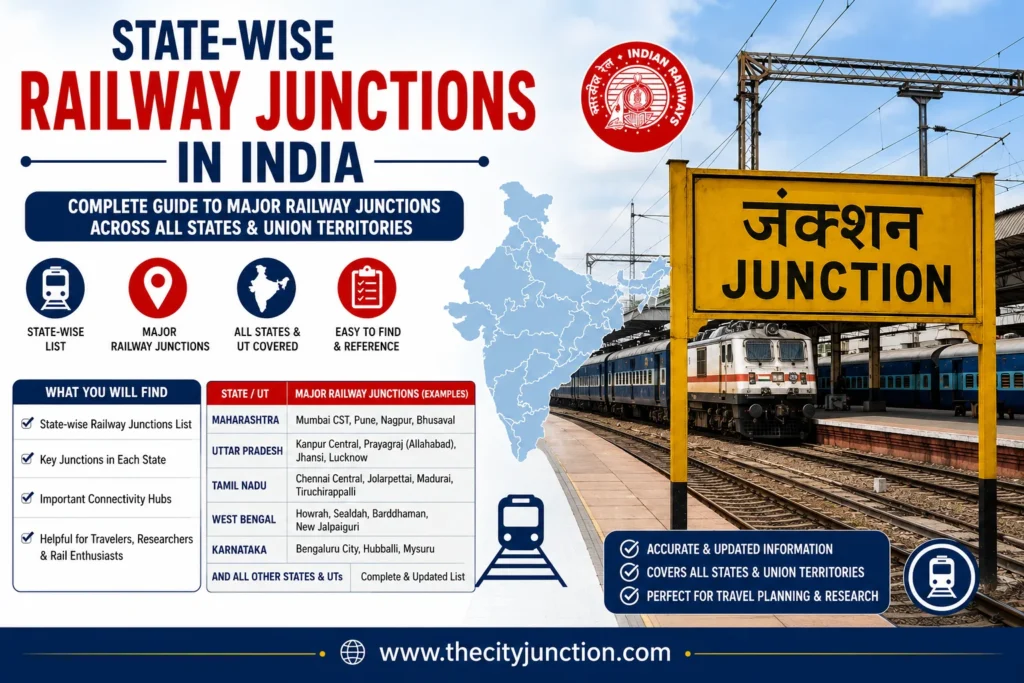
 India has one of the world’s largest railway networks, with hundreds of railway junctions connecting major cities, industrial regions, tourist destinations, and state capitals. These junctions play a vital role in ensuring smooth passenger travel and efficient freight movement across the country.
If you’re looking for railway junctions in a specific state, this guide provides a state-wise directory of important railway junctions across India. Each state page can also help you explore detailed information such as station facilities, railway zones, station codes, train connectivity, and nearby transport options.
Quick Information
| Details | Information |
| Topic | State-wise Railway Junctions in India |
| Coverage | Major Railway Junctions Across Indian States |
| Suitable For | Passengers, Railway Enthusiasts, Students & Tourists |
| Includes | Important Junctions, Railway Zones & Future State Guides |
| Updated | 2026 |
Why Search Railway Junctions State-Wise?
Searching railway junctions by state makes it easier to:
- Find important junctions near your city.
- Plan long-distance train journeys.
- Understand railway connectivity within a state.
- Discover major interchange stations.
- Explore railway infrastructure across India.
State-wise Railway Junction List
Below is a list of major railway junctions arranged state by state.
Andhra Pradesh
Andhra Pradesh is one of the most important railway states in South India and is served mainly by the South Central Railway.
Major Railway Junctions
- Vijayawada Junction
- Guntakal Junction
- Renigunta Junction
- Gudur Junction
- Guntur Junction
- Samalkot Junction
Highlights
- Connects South, East, and Central India.
- Home to Vijayawada, one of India’s busiest railway junctions.
Assam
Important junctions include:
- Lumding Junction
- New Bongaigaon Junction
- Rangiya Junction
These stations connect Northeast India with the rest of the country.
Bihar
Major railway junctions include:
- Barauni Junction
- Kiul Junction
- Samastipur Junction
- Muzaffarpur Junction
- Bakhtiyarpur Junction
Bihar has an extensive railway network connecting eastern and northern India.
Chhattisgarh
Important junctions include:
- Durg Junction
- Raipur Junction
- Bilaspur Junction
These junctions are significant for both passenger and freight transportation.
Delhi
Delhi serves as the national railway gateway.
Major junctions include:
- New Delhi Junction
- Old Delhi Junction
- Hazrat Nizamuddin Junction
These stations connect almost every major city in India.
Gujarat
Major railway junctions:
- Ahmedabad Junction
- Vadodara Junction
- Surat Junction
- Anand Junction
- Viramgam Junction
The state’s railway network supports tourism, business, and industrial transport.
Haryana
Key junctions include:
- Ambala Junction
- Rewari Junction
- Kurukshetra Junction
These stations connect northern and western India.
Himachal Pradesh
The state has limited broad-gauge connectivity.
Important stations include:
- Una Himachal
- Pathankot (gateway for hill railways)
Jharkhand
Major junctions:
- Dhanbad Junction
- Bokaro Steel City Junction
- Tatanagar Junction
These junctions are vital for mineral and industrial transportation.
Karnataka
Important railway junctions include:
- Yesvantpur Junction
- Hubballi Junction
- Mysuru Junction
- Arsikere Junction
These stations connect Karnataka with neighboring states.
Kerala
Major railway junctions:
- Palakkad Junction
- Shoranur Junction
- Ernakulam Junction
- Thrissur Junction
Kerala’s railway network supports tourism and daily commuters.
Madhya Pradesh
Central India’s railway hub.
Important junctions include:
- Itarsi Junction
- Katni Junction
- Bina Junction
- Jabalpur Junction
Itarsi Junction is among the busiest railway junctions in India.
Maharashtra
Major railway junctions:
- Nagpur Junction
- Bhusaval Junction
- Manmad Junction
- Daund Junction
- Pune Junction
Maharashtra has one of India’s busiest railway networks.
Odisha
Important junctions:
- Khurda Road Junction
- Cuttack Junction
- Sambalpur Junction
- Jharsuguda Junction
These stations connect eastern India with central and southern regions.
Punjab
Major railway junctions:
- Ludhiana Junction
- Jalandhar Junction
- Pathankot Junction
Punjab has strong rail connectivity for both passengers and freight.
Rajasthan
Important junctions include:
- Jaipur Junction
- Ajmer Junction
- Sawai Madhopur Junction
- Phulera Junction
These junctions connect Rajasthan with North and West India.
Tamil Nadu
Tamil Nadu has one of the most developed railway networks in South India.
Major junctions include:
- Chennai Egmore
- Tiruchirappalli Junction
- Madurai Junction
- Salem Junction
- Erode Junction
- Villupuram Junction
Telangana
Key railway junctions:
- Secunderabad Junction
- Kazipet Junction
These are important stations under the South Central Railway.
Uttar Pradesh
One of the largest railway networks in India.
Major junctions include:
- Prayagraj Junction
- Mathura Junction
- Agra Junction
- Tundla Junction
- Jhansi Junction
- Gorakhpur Junction
- Pt. Deen Dayal Upadhyay Junction
The state serves as a major railway corridor connecting North, East, Central, and Western India.
Uttarakhand
Important railway junctions include:
- Haridwar Junction
- Laksar Junction
These stations are important for pilgrims and tourists.
West Bengal
Major railway junctions:
- Howrah Junction
- Bardhaman Junction
- Kharagpur Junction
- New Jalpaiguri Junction
- Sealdah
West Bengal serves as the primary railway gateway to Northeast India.
Indian States with the Highest Number of Railway Junctions
| State | Railway Network Strength |
| Uttar Pradesh | Very High |
| Maharashtra | Very High |
| Tamil Nadu | High |
| Madhya Pradesh | High |
| Gujarat | High |
| West Bengal | High |
| Andhra Pradesh | High |
| Bihar | High |
Railway Zones Covering Multiple States
India’s railway network is divided into several zones, including:
- Northern Railway
- Southern Railway
- Western Railway
- Central Railway
- Eastern Railway
- North Central Railway
- South Central Railway
- East Central Railway
- South Eastern Railway
- North Eastern Railway
- West Central Railway
- North Western Railway
- East Coast Railway
- South Western Railway
- South East Central Railway
- North Frontier Railway
- Metro Railway (Kolkata)
How to Choose the Right Railway Junction?
When planning your journey, consider:
- Availability of direct trains.
- Number of connecting routes.
- Passenger facilities.
- Distance from your destination.
- Nearby metro, bus, or taxi services.
- Waiting rooms and retiring rooms for long layovers.
Frequently Asked Questions
Which state has the largest railway network?
Uttar Pradesh, Maharashtra, and Tamil Nadu are among the states with the most extensive railway connectivity.
Which is the busiest railway junction in India?
Some of the busiest railway junctions include New Delhi Junction, Howrah Junction, Vijayawada Junction, Itarsi Junction, and Pt. Deen Dayal Upadhyay Junction.
Are all railway stations junctions?
No. Only stations where three or more railway routes meet or branch are generally known as railway junctions.
Why are railway junctions important?
Railway junctions improve connectivity, reduce travel time, support freight movement, and allow trains to change routes efficiently.
Will more railway junctions be added in the future?
Yes. As Indian Railways expands its network and upgrades stations, new junctions may be created over time.
Conclusion
Railway junctions are the backbone of India’s railway network, connecting thousands of trains and millions of passengers every day. Whether you’re searching for junctions in your home state or planning an interstate journey, a state-wise railway junction list makes it easy to understand India’s rail connectivity.
As this website grows, each state listed above will include a dedicated page featuring a complete list of railway junctions, station codes, railway zones, facilities, train routes, and detailed travel information, making this directory a one-stop resource for railway travellers across India.